Automotive engineering
Pattern Morphing Tire and Topography Adaptivity (AMAT)
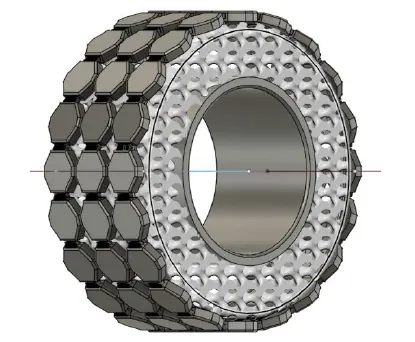
An airless tire with a gyroid lattice core and a servo-actuated tread that changes its pattern to suit the terrain.
Mission profile
- Tire type
- Non-pneumatic (airless)
- Internal structure
- Gyroid lattice
- Tread
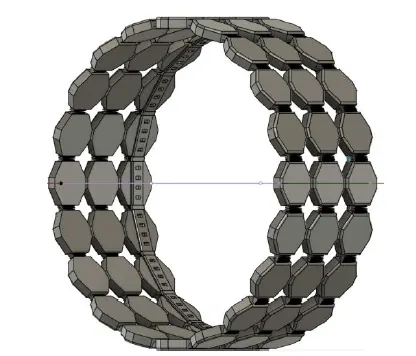
- Modular, servo-actuated
- Adaptation time
- Under 2 seconds
- Traction gain
- +70% on varied terrain
- Target platforms
- EV, autonomous, robotics
What this actually is
A pneumatic tire is a pressure vessel that happens to be a wheel. Everything good about it, the comfort, the grip, the load capacity, depends on the air staying inside. Puncture it and all of that is gone at once. On a road that is an inconvenience; somewhere you cannot be reached, it ends the journey.
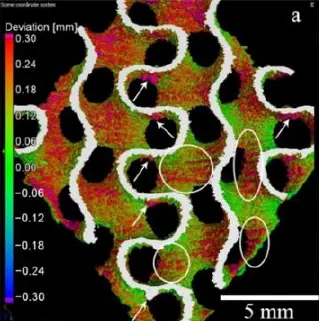
Airless tires remove that single point of failure by replacing the air with structure. A lattice inside the wheel does the job the pressure used to do, absorbing shock and spreading load through geometry instead of inflation. A gyroid lattice is a particularly good choice: its continuously curved surface distributes stress evenly instead of concentrating it at joints, and it can be tuned by changing the geometry rather than the material.
The second idea in AMAT is that the tread should not be fixed either. A pattern optimised for dry tarmac is wrong for loose gravel or soft sand, yet a conventional tire commits to one compromise for life. Servo-actuated tread segments let the surface reconfigure as the terrain changes. Planetary rovers already run on non-pneumatic wheels for the same reason, so the architecture that helps an electric car on a broken road is the one a rover needs to cross regolith.
Overview
The Adaptive Morphing Airless Tire (AMAT) is designed to overcome the limits of pneumatic tires: punctures, uneven wear and poor adaptability to changing terrain. A gyroid-based internal lattice provides shock absorption, durability and uniform stress distribution with no air pressure.
A modular, servo-actuated outer tread adapts in real time using sensor input and machine learning, improving grip and stability from city roads to off-road terrain. AMAT is designed to fit existing vehicle architectures, so it can be integrated into current and future electric and autonomous vehicles without major modification. Early prototypes and simulation results also point to uses in robotics and space exploration.
Role
Research engineer, mechanical design and adaptive systems
Worked with materials scientists and control engineers.
Key requirements
- Terrain recognition
- Pattern morphing mechanism
- Real-time adaptation
- Durability testing
Approach
- Requirements analysis
- Mechanism design
- Control system development
- Materials research
- Testing and validation
Engineering notes
Tools
- SolidWorks
- ANSYS
- MATLAB
- Arduino
- 3D printing
- Assumptions
- Controlled testing environment and ideal sensor performance.
- Limitations
- Limited morphing speed and simplified terrain models.
- Validation
- Terrain adaptation testing, durability assessment and performance evaluation.
Results
- 70% better traction on varied terrain
- Pattern adaptation in under 2 seconds
Deliverables
Prototype tire system, research paper, patent documentation and testing reports.