Space robotics
International Space Robotics Competition and Conference
SYNEIN, a two-robot autonomous exploration system built for an international space robotics competition.

Mission profile
- Robots
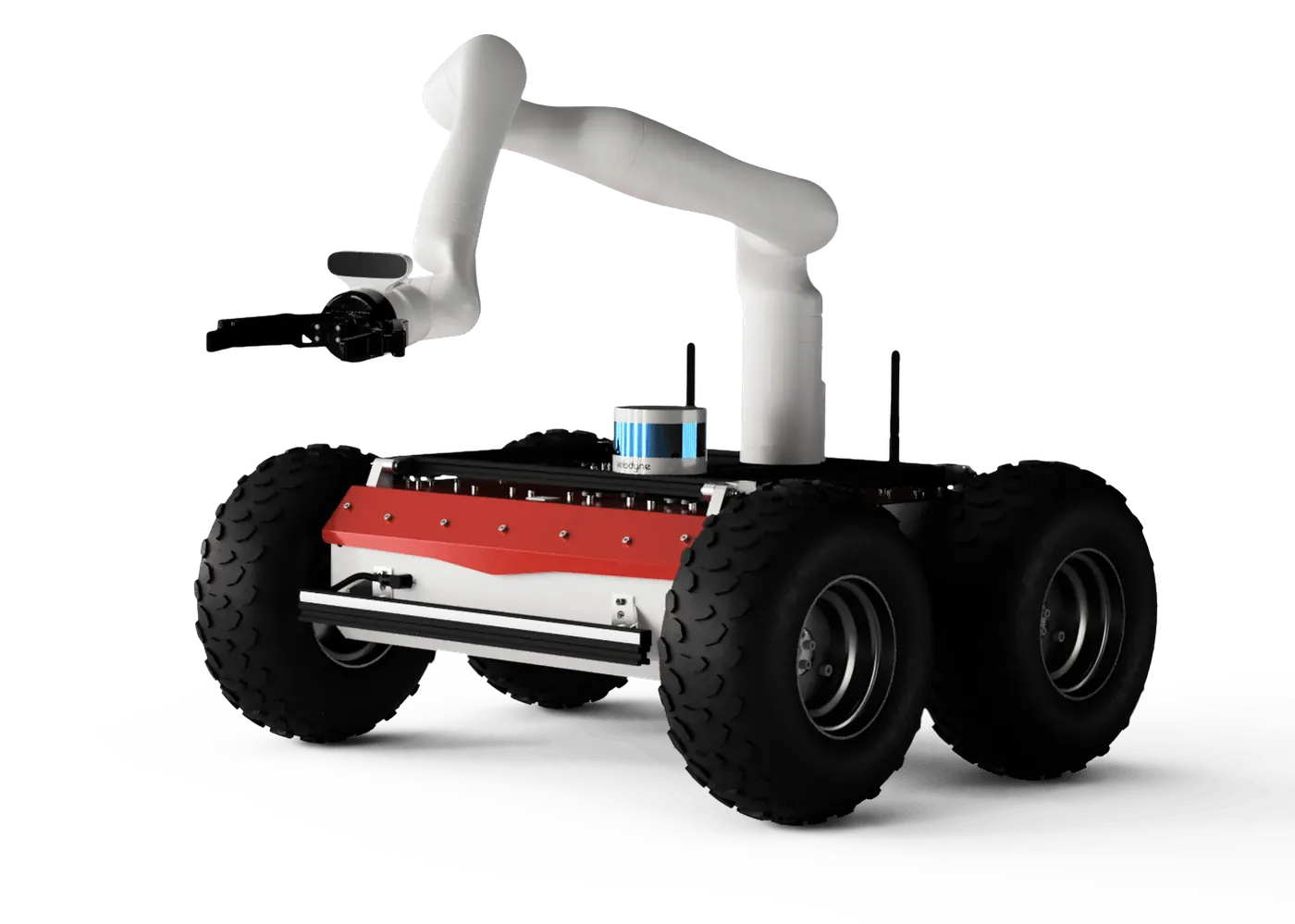
- Husarion Panther and Lynx
- Architecture
- Cooperative dual-robot
- Navigation
- AI-based, autonomous
- Autonomy
- 30+ minutes
- Manipulation tolerance
- Within 2 mm
- Competition result
- Top 20, international
What this actually is
A rover on another world cannot be driven like a remote-control car. Radio signals take minutes to cross the distance to Mars, and the delay runs both ways, so by the time an operator on Earth sees a hazard the rover has already been sitting in front of it for several minutes. Real-time joysticking is physically impossible. The machine has to understand its surroundings and decide how to move.
That requirement defines the field. A planetary robot must read the terrain from its own sensors, judge which ground is safe, plan a route and recover on its own when something goes wrong, all within a strict power and computation budget and with no one available to intervene. Getting stuck is not an inconvenience; it can end a mission.
Splitting the work between robots is a powerful answer. A fast, rugged platform scouts ahead and builds the map, while a smaller, more precise unit follows for close-up inspection and sample collection. They share what they learn, so coverage and sampling precision no longer compete for the same vehicle. SYNEIN (Symbiotic Navigation and Exploration Intelligence Network) is built on exactly that division of labour.
Overview
SYNEIN pairs two robots, the Husarion Panther and the Lynx. The system uses AI-based cooperative navigation, real-time terrain assessment and adaptive task distribution to cross rough, difficult ground.
The Panther is the scouting and mapping platform, tracking across unknown terrain to locate sample sites. The Lynx is the precise, agile investigator that handles close-up sample collection and analysis. Together they refine the exploration strategy and operate autonomously in extraterrestrial-like settings.
Role
Team lead, mechanical design and system integration
Led a team of 6 engineers from mechanical, electrical and software disciplines.
Key requirements
- Autonomous operation
- Space environment simulation
- Precision manipulation
- Communication protocols
Approach
- Competition requirements analysis
- System architecture design
- Mechanical design
- Integration testing
- Competition preparation
Engineering notes
Tools
- SolidWorks
- Arduino
- Python
- ROS
- 3D printing
- Assumptions
- Earth-based testing environment and ideal communication conditions.
- Limitations
- Limited computational resources and simplified environmental conditions.
- Validation
- Functionality testing, autonomous operation verification and competition performance.
Results
- Top 20 finish in the international competition
- Autonomous operation for 30+ minutes
- Manipulation precision within 2 mm
Deliverables
Competition robot, technical report, presentation materials and system documentation.